

The Indian Evidence Act, 1872: A Deep Dive into Its Evolution, Key Provisions, and Modern Relevance
Introduction: Why Does the Indian Evidence Act, 1872 Matter?
Imagine a courtroom where witnesses can say anything without consequences, documents are admitted without scrutiny, and confessions obtained under torture are considered valid. Chaos, right? This was the reality before The Indian Evidence Act, 1872 came into force.
Crafted during British rule, this foundational law governs how evidence is presented, evaluated, and admitted in Indian courts. Even after 150+ years, it remains the backbone of India’s judicial process. But how did it come to be? What are its most critical sections? And does it still hold up in the digital age?
Let’s unravel the fascinating history, key principles, and evolving challenges of The Indian Evidence Act, 1872.
Historical Background: The Birth of the Indian Evidence Act
Pre-1872: A Legal System in Disarray
Before the British introduced codified laws, India followed a mix of:
- Hindu & Islamic laws (based on religious texts)
- Customary practices (varying by region)
- Arbitrary colonial judgments (with no uniform evidence rules)
This inconsistency led to unfair trials, making a structured evidence law necessary.
The Framing of the Act
- Drafted by Sir James Fitzjames Stephen, a renowned jurist.
- Inspired by English common law but adapted to Indian conditions.
- Enacted on March 15, 1872, becoming one of the earliest codified evidence laws in Asia.
Unlike many British-era laws discarded after independence, The Indian Evidence Act, 1872 survived—proving its enduring value.
Key Principles of the Indian Evidence Act, 1872
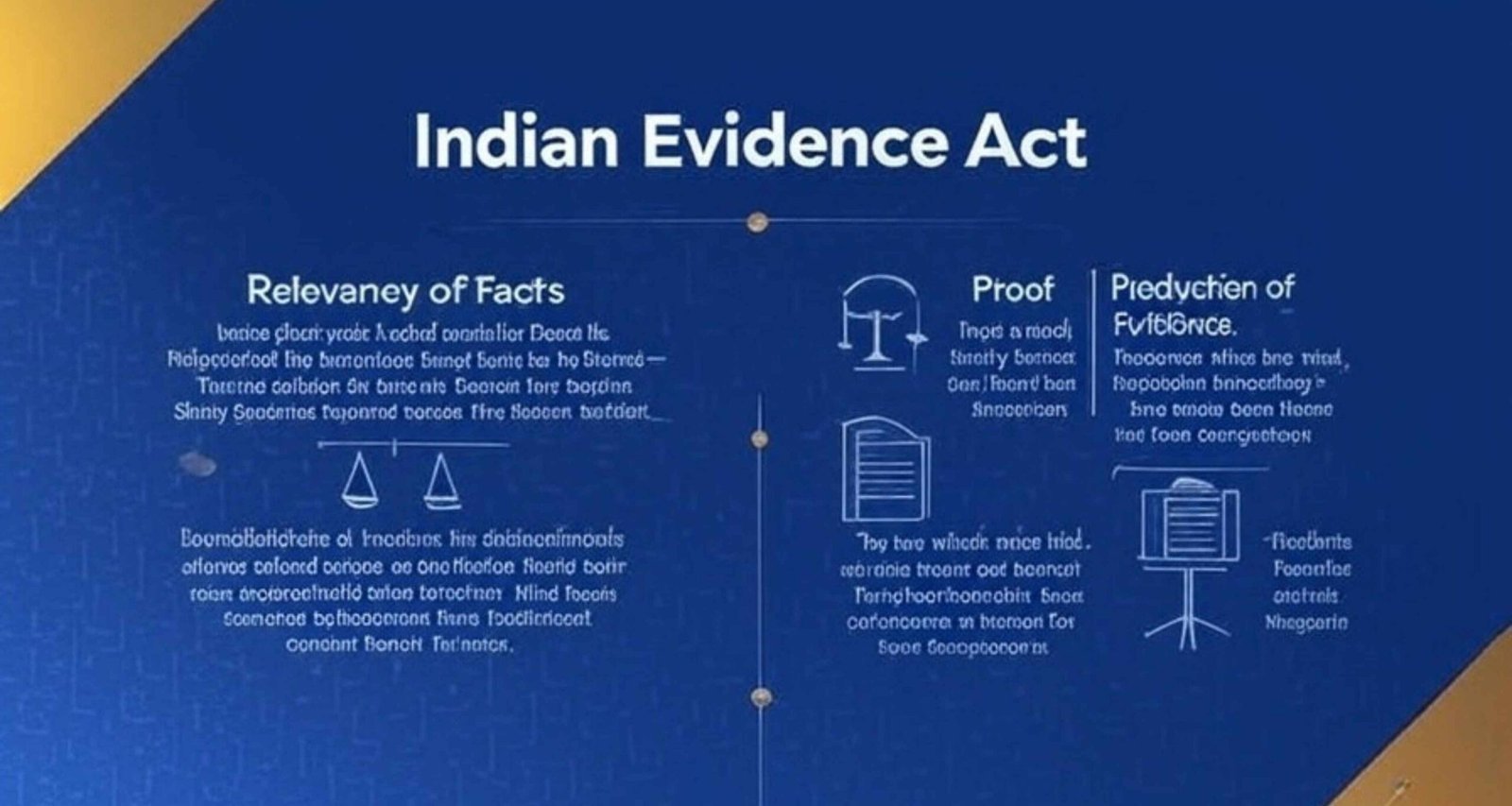
The Act is divided into three main parts:
- Relevancy of Facts (Sections 5–55)
- Proof (Sections 56–100)
- Production & Effect of Evidence (Sections 101–167)
Let’s break down some crucial concepts.
1. Relevancy of Evidence (Sections 5–55)
Not all facts are admissible in court. The Act defines what counts as relevant evidence:
- Facts in issue (Section 5): Directly linked to the case.
- Res gestae (Section 6): Statements made during an event (e.g., a victim’s dying declaration).
- Confessions (Section 24): Must be voluntary; obtained via coercion is inadmissible.
- Opinions (Sections 45–50): Experts (doctors, handwriting analysts) can testify, but lay opinions are restricted.
📌 Landmark Case: State of Maharashtra v. Damu (2000) – The Supreme Court clarified that circumstantial evidence must form a complete chain to convict an accused.
2. Burden of Proof (Sections 101–114)
- “He who asserts must prove” (Section 101).
- Exceptions: In rape cases (Section 114A), if the victim says there was no consent, the burden shifts to the accused.
3. Witness Testimony & Cross-Examination
- Oral evidence (Section 59): Witnesses must testify in person.
- Documentary evidence (Section 61): Original documents preferred over copies.
- Hostile witnesses (Section 154): If a witness turns hostile, the court can discredit them.
📌 Famous Case: Best Bakery Case (2004) – Highlighted witness intimidation issues, leading to witness protection reforms.

4. Digital Evidence & Modern Challenges
Originally designed for paper-based evidence, the Act has adapted to digital age challenges:
- Section 65B: Governs electronic evidence (emails, CCTV footage).
- Landmark Judgment: Shafhi Mohammad v. State of Himachal Pradesh (2018) – Clarified admissibility of electronic records.
Yet, cyber forensics and deepfakes pose new hurdles—should the Act be amended further?
Controversies & Criticisms
Despite its strengths, the Act faces criticism:
✅ Pros
✔ Clear, structured rules for evidence.
✔ Balances fairness & judicial efficiency.
❌ Cons
✘ Outdated terms: Doesn’t fully address AI-generated evidence.
✘ Gender bias: Marital rape exception (Section 122) protects spousal privacy over justice.
✘ Delays: Complex rules sometimes prolong trials.
Conclusion: Is the Indian Evidence Act, 1872 Still Effective?

The Indian Evidence Act, 1872 is a testament to robust legal drafting—surviving colonialism, independence, and the digital revolution. While it has adapted (like allowing electronic evidence), new-age challenges demand further reforms.
What Do You Think?
- Should The Indian Evidence Act, 1872 be overhauled for the 21st century?
- How can India balance traditional legal principles with modern technological evidence?
Let’s discuss in the comments! And if you found this deep dive useful, share it with law students, professionals, and curious minds.
🔗 Further Reading:
Final Thoughts:
The law isn’t just about rules—it’s about justice, fairness, and truth. And The Indian Evidence Act, 1872, despite its age, continues to play a pivotal role in upholding these values.
Would you like a follow-up on “How to Challenge Evidence in Court?” Let me know! 🚀
This response is AI-generated, for reference only.
New chat

Introduction: Why the Muslim Marriage Act 1939 Remains Transformational

Imagine a law passed over 80 years ago that still governs the personal lives of millions today. The Muslim Marriage Act 1939 is one such piece of legislation—a cornerstone of Islamic family law in India, shaping marriage, divorce, and women’s rights within the Muslim community.
But how did this law come into existence? What were the social and political forces behind it? And does it still hold relevance in modern India, where debates around Uniform Civil Code (UCC) and gender justice continue to rage?
In this deep dive, we’ll explore:
- The historical backdrop of the Act
- Its key provisions and legal implications
- How it compares with modern family laws
- Controversies and calls for reform
Let’s unravel the story behind this pivotal legislation.
Historical Context: The Need for the Muslim Marriage Act 1939
Pre-1939: Marriage Laws in British India
Before 1939, Muslim marriage act in India were governed primarily by uncodified Sharia law, interpreted through local customs and colonial courts. This led to inconsistencies, especially concerning women’s rights in marriage and divorce.
Key issues included:
- Unrestricted polygamy without safeguards for wives
- Easy talaq (divorce) with minimal financial protection for women
- Child marriages, with no minimum age restrictions
The Push for Codification
The early 20th century saw growing reformist movements within the Muslim community. Leaders like Maulana Ashraf Ali Thanvi and women’s rights activists demanded legal safeguards.
The Dissolution of Muslim Marriages Act 1939 was introduced to:
✔ Give Muslim women the right to seek divorce under specific conditions
✔ Prevent arbitrary talaq without judicial oversight
✔ Address child marriage concerns (though indirectly)
This was a progressive step at the time—but was it enough?

Key Provisions of the Muslim Marriage Act 1939
The Act primarily deals with dissolution of marriage (talaq) but also impacts other marital rights. Here’s a breakdown:
1. Grounds for Divorce (Section 2)
A Muslim woman could seek divorce if:
- Husband’s whereabouts unknown for 4+ years
- Failure to provide maintenance for 2+ years
- Husband imprisoned for 7+ years
- Impotency at the time of marriage
- Cruelty or desertion
This was revolutionary—it gave women an exit route from abusive marriages.

2. Judicial Intervention in Talaq
Unlike triple talaq (instant divorce), which was still permissible, the Act required court intervention for women-initiated divorces, ensuring fairness.
3. Impact on Child Marriage
While not explicitly banning child marriage, the Act allowed girls married as minors to annul their marriages upon puberty—a subtle but crucial protection.
Comparison with Modern Laws: Has the Act Aged Well?
| Aspect | Muslim Marriage Act 1939 | Modern Reforms (Post-2017) |
|---|---|---|
| Divorce Rights | Women could seek divorce on specific grounds | Triple talaq banned (2019) |
| Polygamy | No restrictions | Debates on UCC to regulate polygamy |
| Child Marriage | Limited safeguards | Prohibition of Child Marriage Act (2006) applies but conflicts with personal laws |
The Big Question: Is the 1939 Act outdated in today’s context? While it was progressive for its time, modern feminist scholars argue that:
- It doesn’t go far enough in preventing unilateral divorce
- Maintenance laws still favor men (as seen in Shah Bano case, 1985)
- No uniform age of marriage for Muslims, unlike other communities
Controversies & Calls for Reform
1. Clash with Gender Justice
Critics argue that the Act doesn’t fully align with constitutional equality (Article 14, 15). Cases like Shayara Bano (2017) highlighted how instant triple talaq left women destitute, leading to its eventual ban.
2. Uniform Civil Code Debate
The BJP-led push for UCC seeks to replace religion-based laws like the 1939 Act with a gender-neutral code. Supporters say this will ensure equality, while opponents fear loss of religious identity.
3. Judicial Interpretations
Courts have expanded women’s rights under the Act:
- Right to khula (woman-initiated divorce) recognized
- Maintenance rights strengthened post-Shah Bano
Yet, implementation remains inconsistent.
Conclusion: Is the Muslim Marriage Act 1939 Still Relevant?
The Muslim Marriage Act 1939 was a landmark in its time, offering Muslim women legal recourse in oppressive marriages. However, societal changes and feminist movements demand further reforms—whether through updated interpretations or a Uniform Civil Code.
What do you think?
- Should the 1939 Act be amended to align with modern gender justice principles?
- Or should Muslim personal laws remain untouched as a matter of religious freedom?
Share your thoughts in the comments!
Further Reading:
- The Shah Bano Case & Its Aftermath
- Triple Talaq Ban: What Changed in 2019?
- Uniform Civil Code: Pros and Cons
By blending historical insights, legal analysis, and modern debates, this post offers a fresh perspective on a decades-old law that still shapes lives today. 🚀
New chat
Operation Sindoor: India’s Precision Strike Against Terror
Introduction: A Swift and Decisive Response to Terror
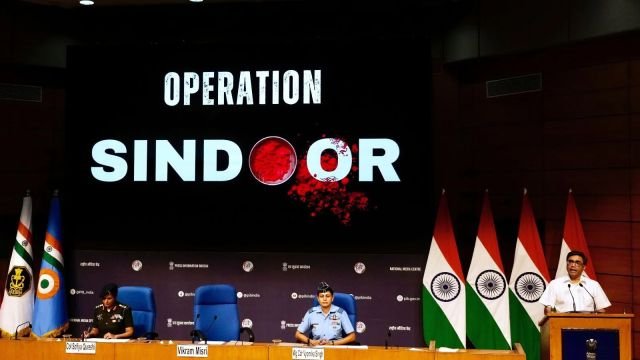
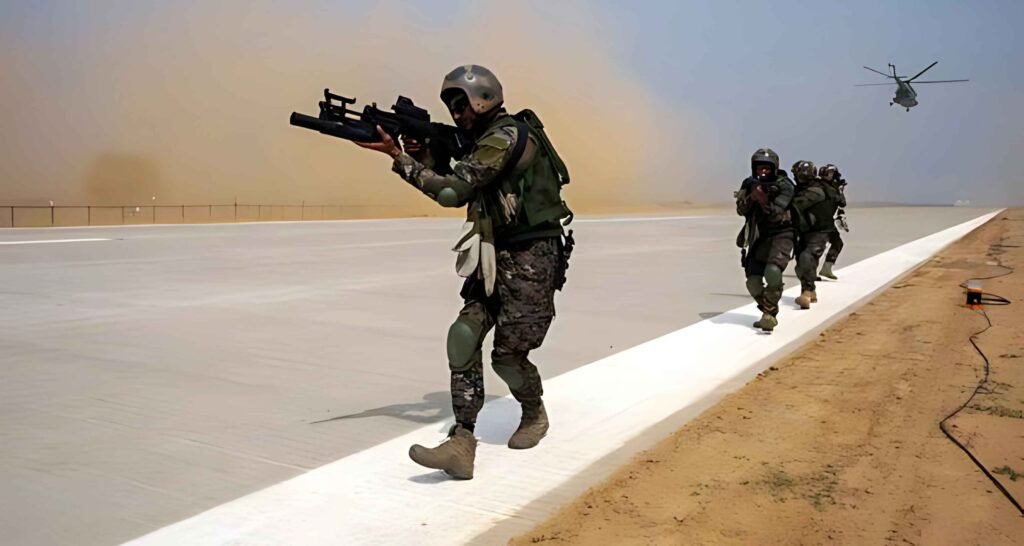
On a quiet morning in the Kashmir Valley, the echoes of gunfire shattered the peace. The Pahalgam terrorist attack claimed the lives of 25 Indians and a Nepali national, leaving a nation in mourning and demanding justice. In response, the Indian Armed Forces launched Operation Sindoor—a meticulously planned, surgical strike targeting terrorist infrastructure across Pakistan and Pakistan-occupied Jammu and Kashmir (PoJK).
This was not an act of war against a nation, but a measured, non-escalatory counter-terror operation aimed solely at dismantling the networks behind the bloodshed. Nine key terror hubs were neutralized, sending a clear message: India will no longer tolerate terrorism emanating from across its borders.
In this deep dive, we explore:
✔ What Operation Sindoor entailed
✔ The strategic targets hit and why they mattered
✔ India’s policy of restraint and precision
✔ The global implications of this operation
✔ What comes next in India’s fight against terror
The Trigger: The Pahalgam Massacre
Before understanding Operation Sindoor, we must revisit the gruesome Pahalgam attack—the catalyst for India’s decisive response.
Key Details of the Attack:
- Location: Pahalgam, a serene tourist town in Jammu & Kashmir.
- Casualties: 25 Indians, 1 Nepali national killed.
- Perpetrators: Jaish-e-Mohammed (JeM) and Lashkar-e-Taiba (LeT)—Pakistan-based terror groups with a long history of targeting India.
- Modus Operandi: Heavily armed militants ambushed a civilian convoy.
The attack was not just an act of terror but a deliberate provocation, testing India’s resolve. Prime Minister Narendra Modi had vowed that “the perpetrators will not go unpunished.” Operation Sindoor was the fulfillment of that promise.
What Was Operation Sindoor?
Unlike full-scale military engagements, Operation Sindoor was a high-precision, intelligence-driven strike designed to minimize collateral damage while maximizing impact on terror infrastructure.
Key Features of the Operation:
✅ Discriminate Targeting – Only terror launchpads, not Pakistani military installations.
✅ Non-Escalatory – Avoided actions that could trigger a wider conflict.
✅ Swift & Covert – Conducted with minimal prior publicity to ensure surprise.
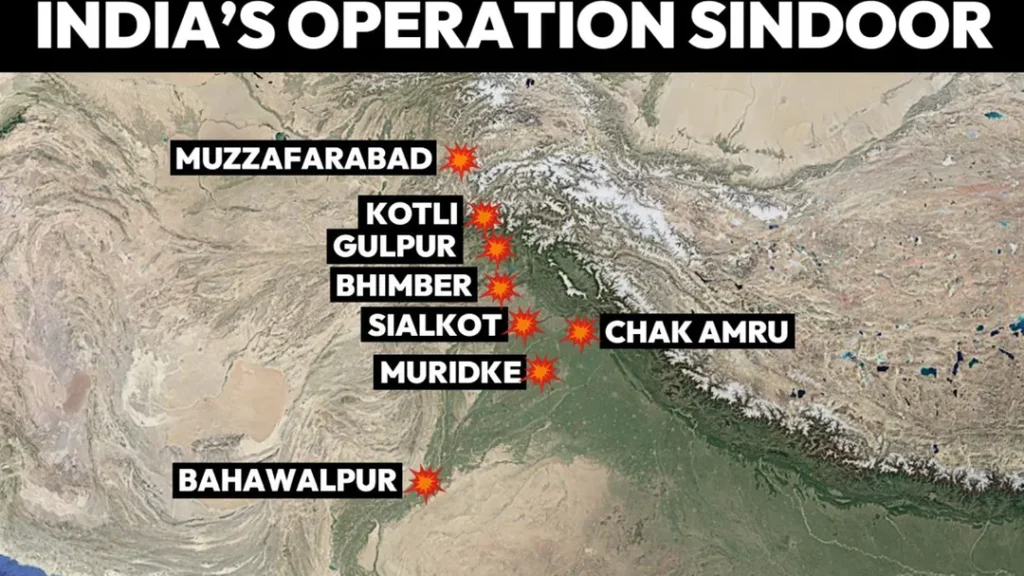
The Nine Targets Hit
| Location | Terror Group | Significance |
|---|---|---|
| Markaz Subhan Allah, Bahawalpur | JeM | JeM’s key recruitment & training hub |
| Markaz Taiba, Muridke | LeT | Headquarters of Lashkar-e-Taiba |
| Sarjal, Tehra Kalan | J… | Key transit point for infiltrators |
| Mehmoona Joya, Sialkot | HM (Hizbul Mujahideen) | Arms storage & militant hideout |
| Markaz Ahle Hadith, Barnala | LeT | Radicalization center |
| Markaz Abbas, Kotli | JeM | Operational command post |
| Maskar Raheel Shahid, Kotli | JeM | Training facility for suicide bombers |
| Shawai Nalla Camp, Muzaffarabad | LeT | Launchpad for cross-border attacks |
| Syedna Bilal Camp, Muzaffarabad | JeM | Logistics & communication hub |
Each of these locations had been meticulously surveilled before the strike, ensuring maximum damage to terror networks while avoiding civilian harm.
Why These Targets?
India’s selection of targets was strategic, not random. Here’s why these locations were critical:
1. Disrupting Command & Control
- Muridke (LeT HQ) and Bahawalpur (JeM HQ) were nerve centers for terror operations.
- Destroying them meant delaying future attacks and crippling leadership.
2. Cutting Off Infiltration Routes
- Sarjal (Tehra Kalan) and Shawai Nalla (Muzaffarabad) were key transit points for militants crossing into India.
3. Eliminating Arms & Training Facilities
- Mehmoona Joya (Sialkot) stored weapons, while Maskar Raheel Shahid (Kotli) trained suicide bombers.
4. Countering Radicalization
- Markaz Ahle Hadith (Barnala) was a recruitment hub, radicalizing youth into jihad.
By hitting these nodes, India ensured long-term degradation of terror capabilities.
India’s Restraint: A Message to Pakistan & the World
Unlike Pakistan’s indiscriminate shelling along the LoC, India’s operation was:
✔ Precision-based (only terror camps, no military targets)
✔ Legally justified (self-defense under UN Charter, Article 51)
✔ Diplomatically sound (avoided escalation while asserting strength)
This approach forced Pakistan into a dilemma:
- If they retaliated, they’d be seen as protecting terrorists.
- If they didn’t, they’d admit their terror infrastructure existed.
Global Reactions & Implications
Supportive Nations:
🇺🇸 USA: “India has the right to defend itself.”
🇫🇷 France: “Terrorism cannot be tolerated.”
🇷🇺 Russia: Backed India’s anti-terror stance.
Pakistan’s Response:
- Denied existence of terror camps (despite satellite evidence).
- Threatened “befitting response” but took no concrete action.
What This Means for Future Counter-Terror Ops:
- India has set a precedent: Cross-border strikes will be used if needed.
- Pakistan’s credibility eroded: Global pressure to act on terror groups will increase.
Conclusion: Justice Served, But the Fight Continues
Operation Sindoor was more than a military strike—it was a statement. India has shown that:
✔ Terrorism will be met with decisive force.
✔ Restraint does not mean weakness.
✔ The world stands with victims, not perpetrators.
What’s Next?
- Will Pakistan finally dismantle terror networks?
- Will the UN take stronger action against state-sponsored terror?
Your Thoughts?
Do you believe Operation Sindoor will deter future attacks? Comment below!
The 2025 Pahalgam Terrorist Attack: A Dark Day in India’s History

On April 22, 2025, a serene tourist haven in the Indian-administered Kashmir, Pahalgam, transformed into a scene of horror. The Pahalgam terrorist attack saw 26 civilians murdered by five armed militants in a brutal, targeted massacre. This act, aimed largely at non-Muslim tourists, is now remembered as the worst civilian attack in India since the 2008 Mumbai siege.

The Setting: Baisaran Valley, Pahalgam
Often described as “Mini Switzerland,” Baisaran Valley in Pahalgam is known for its stunning meadows, surrounded by pine forests and snow-clad peaks. It attracts thousands of tourists annually, particularly honeymooners and nature enthusiasts.
But on that fateful April day, the valley’s scenic beauty was marred by bloodshed. The assailants, armed with M4 carbines and AK-47s, infiltrated the area wearing military uniforms. The location’s limited accessibility—reachable only by foot or pony—made it an easy target for an ambush.
Anatomy of the Pahalgam terrorist Attack
Timeline of Events
- 12:30 PM: Militants entered Baisaran Valley.
- 12:45 PM: Gunfire erupted as they began singling out tourists.
- 1:00 PM: The first video, inadvertently filmed by a ziplining tourist, went viral.
- 1:15 PM: Local authorities were alerted.
- 3:00 PM: Rescue operations began; injured were rushed to Anantnag and Srinagar hospitals.
Targeted Killings in Pahalgam terrorist attack
According to survivor testimonies and media footage, the attackers specifically asked for tourists’ religions. Some were forced to recite the Islamic kalima to prove they were Muslim. Those who couldn’t—largely Hindu men and one Christian tourist—were executed at point-blank range.
One local, Syed Adil Hussain Shah, a Muslim pony handler, tried to wrestle a gun from an attacker and was killed. His bravery, hailed by both Hindu and Muslim communities, offered a glimmer of humanity in an otherwise tragic event.
The Casualty Count
| State/Country | Deaths | Injured |
|---|---|---|
| Maharashtra | 6 | 5 |
| Gujarat | 3 | 2 |
| Karnataka | 3 | 2 |
| West Bengal | 2 | 1 |
| Madhya Pradesh | 2 | 2 |
| Andhra Pradesh | 1 | 1 |
| Other Indian States | 7 | 4 |
| Nepal | 1 | 1 |
| Total | 26 | 17 |
Among the victims were government officials, honeymooning couples, and young professionals. A video of an Indian Navy officer’s wife recounting her husband’s execution shook the nation to its core.
The Claim and Retraction: TRF’s Dubious Role
Initially, The Resistance Front (TRF), believed to be an offshoot of Lashkar-e-Taiba, claimed responsibility. The group framed the massacre as a protest against India’s post-2019 policies in Kashmir, especially the alleged “settler colonialism” through the Jammu and Kashmir Reorganization Act.
However, TRF retracted the claim four days later, citing a “communications breach” and accusing Indian intelligence of being involved. This contradiction only intensified the mystery around the pahalgam terrorist attack’s true planners.
Roots of the Conflict
To fully understand this tragedy, one must revisit Kashmir’s turbulent history:
- Late 1980s: Pakistan-supported insurgency in Kashmir began.
- 2019: Article 370 was revoked, removing the special status of Jammu and Kashmir and enabling non-locals to buy land and settle.
- Post-2019: Rise in attacks on non-locals by insurgent groups like TRF, often under the pretext of protecting demographic integrity.
Pakistan has consistently denied sponsoring terrorism, but evidence from multiple international agencies and think tanks links its intelligence services with groups like LeT and TRF.
The Aftermath: Diplomatic and Military Fallout
India responded with an iron fist:
- Diplomatic Measures:
- Expelled Pakistani diplomats.
- Suspended the Indus Waters Treaty.
- Banned Pakistani imports and shut its airspace to Pakistani airlines.
- Military Response:
- Launched Operation Sindoor on May 7, 2025, targeting terror camps inside Pakistan.
- Engaged in cross-border skirmishes, escalating tensions.
- Search Operations:
- More than 1,500 people were detained in J&K for questioning.
- Houses of alleged militants were demolished.

Acts of Heroism and Unity in Pahalgam terrorist attack
Despite the horror, acts of unity emerged:
- Local Muslims helped evacuate injured tourists.
- Sikh gurudwaras opened their doors for fleeing tourists.
- Pony-handlers risked their lives to ferry victims down from the valley.
These actions challenged the communal narrative the attackers tried to foster.
The Motive: Destabilizing Progress
Foreign Secretary Vikram Misri, post-Operation Sindoor, asserted that the pahalgam terrorist attack aimed to stoke communal discord and derail economic progress in Kashmir.
- Tourism Surge: Kashmir saw 23 million tourists in 2024, a historic high.
- Economic Growth: Tourism contributed significantly to the UT’s GDP.
- TRF’s Threat: Their doctrine targets anyone settling in Kashmir, calling them agents of Indian expansionism.
By disrupting tourism, militants hoped to sabotage this fragile normalcy.
The Media and Public Response
Indian media covered the event extensively, prompting emotional public reactions:
- Hashtags like #PahalgamTerroristAttack, #JusticeForVictims, and #StopTerrorism trended for weeks.
- Protest marches were held across Indian cities.
- Memorial vigils were organized in Pune, Delhi, and Hyderabad.
The visuals of mourning families, particularly of the newlywed widows, struck a chord nationwide.
Lessons and the Path Ahead
The Pahalgam terrorist attack is a stark reminder that:
- Religious hatred remains a tool for terrorism.
- Geopolitical conflicts continue to endanger civilian lives.
- Democratic nations must safeguard minority communities.
What Must Be Done?
- Enhanced Security in Tourist Hubs: Drones, surveillance, and better ground patrols.
- Improved Intelligence Sharing: Inter-agency and international cooperation.
- Counter-Radicalization Programs: Especially targeting youth in conflict-prone areas.
- Global Diplomacy: Build pressure on state-sponsors of terror through UN and bilateral channels.

Final Reflections
The Pahalgam terrorist attack isn’t just another headline. It represents a targeted hatred aimed at destabilizing a region inching toward peace. But it also showcased India’s resilience—through the bravery of locals, swift government action, and a united national response.
As Kashmir heals, it’s imperative we remember the lives lost—not just as statistics, but as stories of love, courage, and hope violently cut short.
💬 Share Your Voice
What are your thoughts on the Pahalgam terrorist attack and its broader implications? Drop your comments below, or explore our detailed coverage of India-Pakistan relations, terrorism in South Asia, and Kashmir’s tourism revival.
Stay informed. Stay vigilant. Stay united.
Understanding Trespass to Land: A Deep Dive into the Law of Tort

Introduction: What Is Trespass to Land?
Imagine coming home to find a stranger camping in your backyard without permission. Or perhaps a neighbor repeatedly cuts through your lawn despite your objections. These scenarios aren’t just annoying—they could be trespass to land, a well-established tort in common law.
Trespass to land occurs when someone intentionally enters another person’s property without lawful justification. It’s one of the oldest legal concepts, dating back to medieval England, yet remains highly relevant today—especially in disputes over property boundaries, unauthorized construction, or even drone intrusions.
But what exactly constitutes trespass? Are there defenses? And how do courts determine liability? Let’s break it down.

What Constitutes Trespass to Land?
Unlike some torts that require proof of harm, trespass to land is actionable per se—meaning the mere act of unauthorized entry is enough to sue, even if no damage occurs. However, certain elements must be proven:
1. Voluntary Act by the Defendant
The trespass must be intentional or negligent. Accidental entry (e.g., being pushed onto someone’s property) may not always qualify.
2. Physical Invasion of Land
This includes:
- Direct entry (walking, driving, or placing objects on the land).
- Indirect interference (throwing debris, flooding, or even sending drones).
- Remaining on land after permission is revoked (e.g., refusing to leave a store when asked).
3. No Lawful Justification
Authorized entry (e.g., police with a warrant) is not trespass. But mistaken belief (“I thought it was public land!”) is rarely a defense.
Real-World Examples & Case Law

📌 Case Study 1: Basely v. Clarkson (1681)
One of the earliest recorded cases where a landowner sued a neighbor for repeatedly cutting grass on his land. The court ruled that even harmless entry without permission is trespass.
📌 Modern Issue: Drone Trespass
With the rise of drones, courts now grapple with whether aerial surveillance constitutes trespass. In Boggs v. Meredith (2015), a Kentucky court ruled that low-altitude drone flights over private property could be trespass.
📌 Unintentional Trespass?
In League Against Cruel Sports v. Scott (1985), hunt protesters entered private land. The court held that even if the intent was protest-related, the physical entry was still trespass.
Defenses Against Trespass Claims
Not all entries are unlawful. Key defenses include:
✅ Consent (Express or Implied)
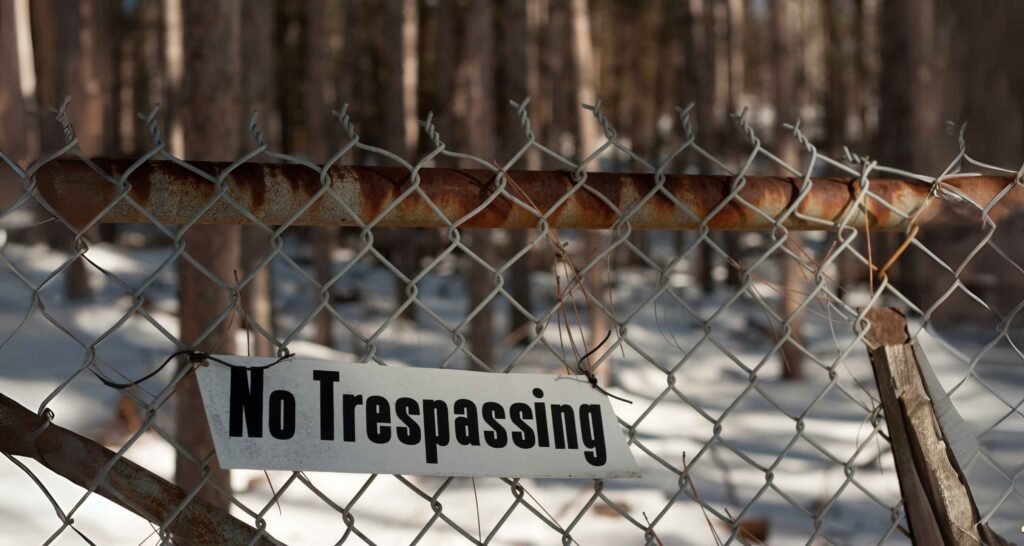
- If a “No Trespassing” sign is absent, courts may assume implied consent (e.g., delivery personnel entering a driveway).
- However, exceeding consent (e.g., a guest entering a locked room) revokes permission.
✅ Necessity
- Emergency situations (e.g., breaking into a house to save someone from a fire).
- But this doesn’t cover convenience (e.g., cutting through a yard to avoid traffic).
✅ Public or Legal Authority
- Law enforcement executing a valid warrant.
- Utility workers accessing land for repairs (if authorized by law).
Remedies for Trespass to Land
Victims can seek:
| Remedy | Description |
|---|---|
| Damages | Compensation for harm (even nominal if no actual loss). |
| Injunction | Court order to stop ongoing trespass (e.g., removing a structure). |
| Ejectment | Legal removal of the trespasser. |
In rare cases, punitive damages apply if the trespass was malicious (e.g., repeatedly ignoring warnings).
Trespass vs. Nuisance: What’s the Difference?
While both protect property rights, they differ:
| Aspect | Trespass to Land | Nuisance |
|---|---|---|
| Nature | Physical invasion. | Indirect interference (noise, pollution). |
| Proof | Actionable per se. | Must prove substantial harm. |
| Example | Someone enters your land. | A factory causes smoke affecting your property |
How to Protect Your Property from Trespass
- Post Clear Signs – “No Trespassing” notices strengthen legal claims.
- Secure Boundaries – Fences, gates, and surveillance deter unauthorized entry.
- Act Promptly – Courts favor landowners who enforce their rights consistently.
Conclusion: Why Trespass to Land Still Matters
From medieval disputes to modern drone debates, trespass to land remains a cornerstone of property law. Whether you’re a homeowner, business owner, or just curious about legal rights, understanding this tort helps protect against unauthorized intrusions.
A fence may keep out neighbors, but only the law can truly protect your land from trespass.