

The Indian Evidence Act, 1872: A Deep Dive into Its Evolution, Key Provisions, and Modern Relevance

indian evidence act

Introduction: Why Does the Indian Evidence Act, 1872 Matter?
indian evidence act
indian evidence act

Imagine a courtroom where witnesses can say anything without consequences, documents are admitted without scrutiny, and confessions obtained under torture are considered valid. Chaos, right? This was the reality before The Indian Evidence Act, 1872 came into force.

Crafted during British rule, this foundational law governs how evidence is presented, evaluated, and admitted in Indian courts. Even after 150+ years, it remains the backbone of India’s judicial process. But how did it come to be? What are its most critical sections? And does it still hold up in the digital age?

Let’s unravel the fascinating history, key principles, and evolving challenges of The Indian Evidence Act, 1872.


Historical Background: The Birth of the Indian Evidence Act

Pre-1872: A Legal System in Disarray

Before the British introduced codified laws, India followed a mix of:

  • Hindu & Islamic laws (based on religious texts)
  • Customary practices (varying by region)
  • Arbitrary colonial judgments (with no uniform evidence rules)

This inconsistency led to unfair trials, making a structured evidence law necessary.

The Framing of the Act

  • Drafted by Sir James Fitzjames Stephen, a renowned jurist.
  • Inspired by English common law but adapted to Indian conditions.
  • Enacted on March 15, 1872, becoming one of the earliest codified evidence laws in Asia.

Unlike many British-era laws discarded after independence, The Indian Evidence Act, 1872 survived—proving its enduring value.


Key Principles of the Indian Evidence Act, 1872

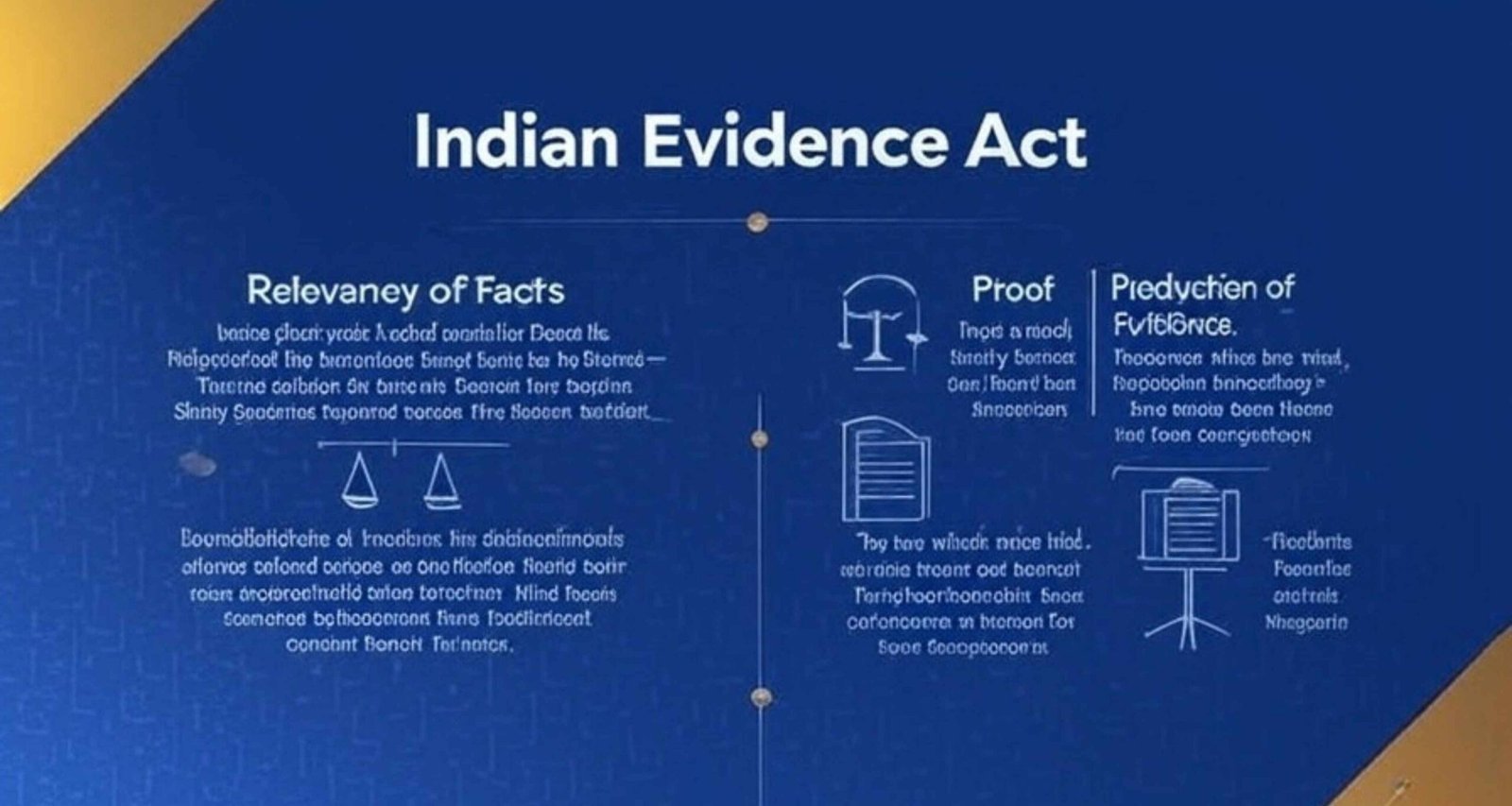
The Act is divided into three main parts:

  1. Relevancy of Facts (Sections 5–55)
  2. Proof (Sections 56–100)
  3. Production & Effect of Evidence (Sections 101–167)

Let’s break down some crucial concepts.

1. Relevancy of Evidence (Sections 5–55)

Not all facts are admissible in court. The Act defines what counts as relevant evidence:

  • Facts in issue (Section 5): Directly linked to the case.
  • Res gestae (Section 6): Statements made during an event (e.g., a victim’s dying declaration).
  • Confessions (Section 24): Must be voluntary; obtained via coercion is inadmissible.
  • Opinions (Sections 45–50): Experts (doctors, handwriting analysts) can testify, but lay opinions are restricted.

📌 Landmark Case: State of Maharashtra v. Damu (2000) – The Supreme Court clarified that circumstantial evidence must form a complete chain to convict an accused.

2. Burden of Proof (Sections 101–114)

  • “He who asserts must prove” (Section 101).
  • Exceptions: In rape cases (Section 114A), if the victim says there was no consent, the burden shifts to the accused.

3. Witness Testimony & Cross-Examination

  • Oral evidence (Section 59): Witnesses must testify in person.
  • Documentary evidence (Section 61): Original documents preferred over copies.
  • Hostile witnesses (Section 154): If a witness turns hostile, the court can discredit them.

📌 Famous Case: Best Bakery Case (2004) – Highlighted witness intimidation issues, leading to witness protection reforms.

indian evidence act
indian evidence act

4. Digital Evidence & Modern Challenges

Originally designed for paper-based evidence, the Act has adapted to digital age challenges:

  • Section 65B: Governs electronic evidence (emails, CCTV footage).
  • Landmark Judgment: Shafhi Mohammad v. State of Himachal Pradesh (2018) – Clarified admissibility of electronic records.

Yet, cyber forensics and deepfakes pose new hurdles—should the Act be amended further?


Controversies & Criticisms

Despite its strengths, the Act faces criticism:
✅ Pros
✔ Clear, structured rules for evidence.
✔ Balances fairness & judicial efficiency.

❌ Cons
✘ Outdated terms: Doesn’t fully address AI-generated evidence.
✘ Gender bias: Marital rape exception (Section 122) protects spousal privacy over justice.
✘ Delays: Complex rules sometimes prolong trials.


Conclusion: Is the Indian Evidence Act, 1872 Still Effective?

indian evidence act
indian evidence act

The Indian Evidence Act, 1872 is a testament to robust legal drafting—surviving colonialism, independence, and the digital revolution. While it has adapted (like allowing electronic evidence), new-age challenges demand further reforms.

What Do You Think?

  • Should The Indian Evidence Act, 1872 be overhauled for the 21st century?
  • How can India balance traditional legal principles with modern technological evidence?

Let’s discuss in the comments! And if you found this deep dive useful, share it with law students, professionals, and curious minds.

🔗 Further Reading:


Final Thoughts:
The law isn’t just about rules—it’s about justice, fairness, and truth. And The Indian Evidence Act, 1872, despite its age, continues to play a pivotal role in upholding these values.

Would you like a follow-up on “How to Challenge Evidence in Court?” Let me know! 🚀

This response is AI-generated, for reference only.

New chat

muslim-marriage-act

Introduction: Why the Muslim Marriage Act 1939 Remains Transformational

muslim-marriage-act

Imagine a law passed over 80 years ago that still governs the personal lives of millions today. The Muslim Marriage Act 1939 is one such piece of legislation—a cornerstone of Islamic family law in India, shaping marriage, divorce, and women’s rights within the Muslim community.

But how did this law come into existence? What were the social and political forces behind it? And does it still hold relevance in modern India, where debates around Uniform Civil Code (UCC) and gender justice continue to rage?

In this deep dive, we’ll explore:

  • The historical backdrop of the Act
  • Its key provisions and legal implications
  • How it compares with modern family laws
  • Controversies and calls for reform

Let’s unravel the story behind this pivotal legislation.


Historical Context: The Need for the Muslim Marriage Act 1939

Pre-1939: Marriage Laws in British India

Before 1939, Muslim marriage act in India were governed primarily by uncodified Sharia law, interpreted through local customs and colonial courts. This led to inconsistencies, especially concerning women’s rights in marriage and divorce.

Key issues included:

  • Unrestricted polygamy without safeguards for wives
  • Easy talaq (divorce) with minimal financial protection for women
  • Child marriages, with no minimum age restrictions

The Push for Codification

The early 20th century saw growing reformist movements within the Muslim community. Leaders like Maulana Ashraf Ali Thanvi and women’s rights activists demanded legal safeguards.

The Dissolution of Muslim Marriages Act 1939 was introduced to:
✔ Give Muslim women the right to seek divorce under specific conditions
✔ Prevent arbitrary talaq without judicial oversight
✔ Address child marriage concerns (though indirectly)

This was a progressive step at the time—but was it enough?


muslim-marriage-act

Key Provisions of the Muslim Marriage Act 1939

The Act primarily deals with dissolution of marriage (talaq) but also impacts other marital rights. Here’s a breakdown:

1. Grounds for Divorce (Section 2)

A Muslim woman could seek divorce if:

  • Husband’s whereabouts unknown for 4+ years
  • Failure to provide maintenance for 2+ years
  • Husband imprisoned for 7+ years
  • Impotency at the time of marriage
  • Cruelty or desertion

This was revolutionary—it gave women an exit route from abusive marriages.

muslim-marriage-act

2. Judicial Intervention in Talaq

Unlike triple talaq (instant divorce), which was still permissible, the Act required court intervention for women-initiated divorces, ensuring fairness.

3. Impact on Child Marriage

While not explicitly banning child marriage, the Act allowed girls married as minors to annul their marriages upon puberty—a subtle but crucial protection.


Comparison with Modern Laws: Has the Act Aged Well?

AspectMuslim Marriage Act 1939Modern Reforms (Post-2017)
Divorce RightsWomen could seek divorce on specific groundsTriple talaq banned (2019)
PolygamyNo restrictionsDebates on UCC to regulate polygamy
Child MarriageLimited safeguardsProhibition of Child Marriage Act (2006) applies but conflicts with personal laws

The Big Question: Is the 1939 Act outdated in today’s context? While it was progressive for its time, modern feminist scholars argue that:

  • It doesn’t go far enough in preventing unilateral divorce
  • Maintenance laws still favor men (as seen in Shah Bano case, 1985)
  • No uniform age of marriage for Muslims, unlike other communities

Controversies & Calls for Reform

1. Clash with Gender Justice

Critics argue that the Act doesn’t fully align with constitutional equality (Article 14, 15). Cases like Shayara Bano (2017) highlighted how instant triple talaq left women destitute, leading to its eventual ban.

2. Uniform Civil Code Debate

The BJP-led push for UCC seeks to replace religion-based laws like the 1939 Act with a gender-neutral code. Supporters say this will ensure equality, while opponents fear loss of religious identity.

3. Judicial Interpretations

Courts have expanded women’s rights under the Act:

  • Right to khula (woman-initiated divorce) recognized
  • Maintenance rights strengthened post-Shah Bano

Yet, implementation remains inconsistent.


Conclusion: Is the Muslim Marriage Act 1939 Still Relevant?

The Muslim Marriage Act 1939 was a landmark in its time, offering Muslim women legal recourse in oppressive marriages. However, societal changes and feminist movements demand further reforms—whether through updated interpretations or a Uniform Civil Code.

What do you think?

  • Should the 1939 Act be amended to align with modern gender justice principles?
  • Or should Muslim personal laws remain untouched as a matter of religious freedom?

Share your thoughts in the comments!


Further Reading:

By blending historical insights, legal analysis, and modern debates, this post offers a fresh perspective on a decades-old law that still shapes lives today. 🚀

New chat